Ethical issues regarding the use of AI in psychotherapy
DOI:
https://doi.org/10.30820/1664-9583-2026-2-17Keywords:
artificial intelligence, psychotherapy, chatbots, therapeutic alliance, ethicsAbstract
Artificial intelligence (AI) is also increasingly establishing itself in psychiatric and psychotherapeutic practice. Against the backdrop of global care disparities, AI-based applications are being discussed or are already in use for screening and diagnostics, clinical decision support, interventions, monitoring, and administrative and educational support. This article analyses opportunities and risks of this development from the perspective of medical ethics. While there are potential benefits, such as improved access to care, destigmatization, clinical decision support, and personalization and training opportunities, there are also significant risks, including insufficient evidence of efficacy, inadequate crisis management, susceptibility to errors ranging up to hallucinations, erosion of the therapeutic alliance, data protection deficits, algorithmic biases, and a regulatory vacuum. Four fundamental ethical questions are discussed in depth: 1. the normative status of AI as a tool or agent, 2. the conditions for trust in conversational AI, 3. simulated empathy, and 4. unrealistic expectations and excessive dependence. Current regulatory frameworks, including the WHO’s guiding principles, the EU AI Act, the EU Medical Device Regulation, and recommendations from professional associations, are also contextualized. Based on this, action-oriented recommendations for psychotherapeutic practice are derived. These include taking a systematic AI-assessment, being transparent about technological limitations, preserving professional judgement and human control, strictly evaluating data protection and security, establishing robust crisis protocols and the development of AI competence. The authentic therapeutic relationship remains the indispensable agent of the therapeutic process. AI should be developed as a complementary tool, not a substitute for human professionals.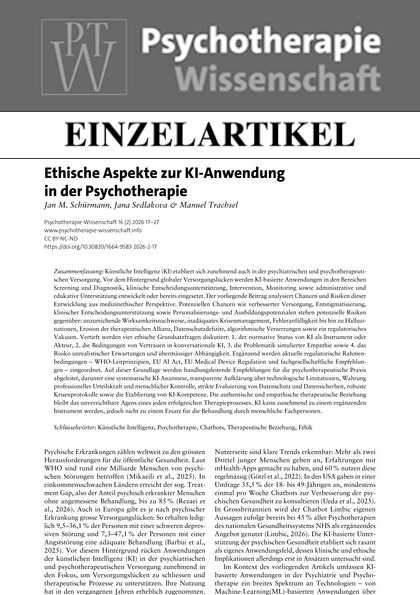
Downloads
How to Cite
Schürmann, J. M., Sedlakova, J., & Trachsel, M. (2026). Ethical issues regarding the use of AI in psychotherapy. Psychotherapie-Wissenschaft, 16(2), 17–27. https://doi.org/10.30820/1664-9583-2026-2-17
Issue
Section
Special Issue
License

This work is licensed under a Creative Commons Attribution-NonCommercial-NoDerivatives 3.0 Unported License.
This journal provides open access to its content in accordance with the basic premise that the free public availability of research benefits the exchange of knowledge throughout the world.
Authors wishing to publish in this journal agree to the following:
- The author/s retain/s the copyrights and consent/s to initial publication of the work in the journal under a Creative Commons Attribution licence, which allows third parties to use the work by citing the name/s of the author/s and this journal as initial publisher (in accordance with the Creative Commons Attribution-NonCommercial-NoDerivs 3.0 DE-Licence).
- The author/s can enter into additional contracts for the non-exclusive distribution (e.g. publish in a collection or book) of the version published in the journal, if the journal is cited as initial publisher.