Psychotherapy for cancer patients with advanced disease
DOI:
https://doi.org/10.30820/1664-9583-2026-2-43Keywords:
psycho-oncology, advanced cancer, existential suffering, CALM, palliative psychotherapy, double awareness, dignity, meaning-makingAbstract
Advanced cancer represents not only a medical but an existential crisis. Beyond diagnosable psychiatric disorders – anxiety, depression, adjustment disorders – many patients experience a form of distress that is diagnostically more elusive: existential suffering, demoralization, and the loss of meaning and dignity. Modern oncological treatments have in many cases substantially extended life expectancy even in the palliative stage, giving rise to new clinical realities that have yet to be adequately addressed by psychotherapy. This article describes the theoretical and empirical framework of evidence-based psychotherapeutic approaches for patients with advanced cancer, with a focus on the CALM approach (Managing Cancer And Living Meaningfully): a manualized, meaning-oriented brief therapy derived from empirical and clinical evidence and grounded in multiple therapeutic traditions. Randomized controlled trials demonstrate its efficacy with respect to depressive symptoms, psychological well-being, and preparation for end of life. A detailed example from psycho-oncological practice outlines the psychotherapeutic work with CALM.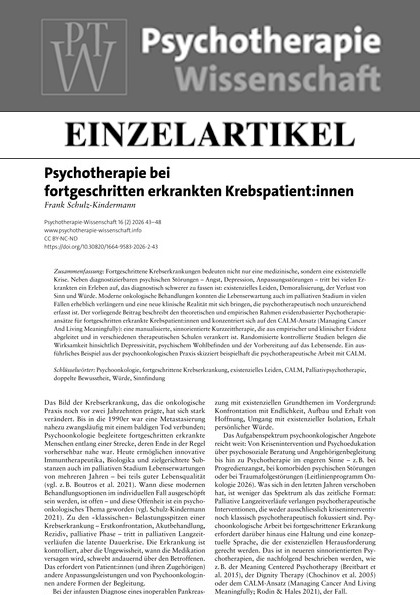
Downloads
How to Cite
Schulz-Kindermann, F. (2026). Psychotherapy for cancer patients with advanced disease. Psychotherapie-Wissenschaft, 16(2), 43–48. https://doi.org/10.30820/1664-9583-2026-2-43
Issue
Section
Original Work
License

This work is licensed under a Creative Commons Attribution-NonCommercial-NoDerivatives 3.0 Unported License.
This journal provides open access to its content in accordance with the basic premise that the free public availability of research benefits the exchange of knowledge throughout the world.
Authors wishing to publish in this journal agree to the following:
- The author/s retain/s the copyrights and consent/s to initial publication of the work in the journal under a Creative Commons Attribution licence, which allows third parties to use the work by citing the name/s of the author/s and this journal as initial publisher (in accordance with the Creative Commons Attribution-NonCommercial-NoDerivs 3.0 DE-Licence).
- The author/s can enter into additional contracts for the non-exclusive distribution (e.g. publish in a collection or book) of the version published in the journal, if the journal is cited as initial publisher.