Who benefits from psychotherapy studies?
On academicization policy, standardized psychotherapy, and the significance of a young discipline for the academic future of schools-based psychotherapy
DOI:
https://doi.org/10.30820/1664-9583-2026-1-63Keywords:
academization, academic psychotherapy, schools-based psychotherapy, unified psychotherapy, psychology, psychotherapy studies (Psychotherapiewissenschaft), therapy schools, standardized therapy schools dialogue (TSD), Sigmund Freud PrivateUniversity (SFU)Abstract
The new Austrian Psychotherapy Act (2024) requires psychotherapy to have an academic and scientific foundation through institutional links to universities. Psychotherapy can find an academic anchor in various university subjects, such as the established fields of psychology, medicine, pedagogics, etc., or in the young field of psychotherapy studies (Psychotherapiewissenschaft, PTW). On the one hand, this article highlights the strategies and trends in academicization policy in German-speaking Central Europe (DACH), thereby establishing a framework for discussion in which a dominant trend is becoming increasingly apparent, one that could be described as »from schools-based psychotherapy to uniform psychotherapy.” On the other hand, this essay presents an alternative academization dynamic that works in the opposite direction and strives to scientifically secure the diversity of therapy schools. Psychotherapy must decide whether it wants to transform itself into a unified discipline in the medium term or whether it wants to continue to see itself as a polymorphous culture of knowledge and practice. In the latter case, psychotherapy will find great support in psychotherapy studies (PTW).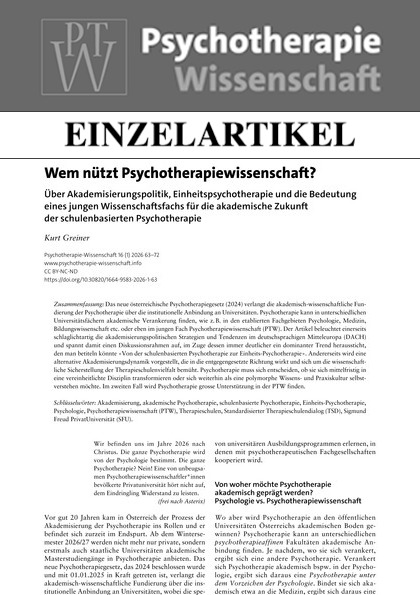
Downloads
How to Cite
Greiner, K. (2026). Who benefits from psychotherapy studies? On academicization policy, standardized psychotherapy, and the significance of a young discipline for the academic future of schools-based psychotherapy. Psychotherapie-Wissenschaft, 16(1), 63–72. https://doi.org/10.30820/1664-9583-2026-1-63
Issue
Section
Debatte
License

This work is licensed under a Creative Commons Attribution-NonCommercial-NoDerivatives 3.0 Unported License.
This journal provides open access to its content in accordance with the basic premise that the free public availability of research benefits the exchange of knowledge throughout the world.
Authors wishing to publish in this journal agree to the following:
- The author/s retain/s the copyrights and consent/s to initial publication of the work in the journal under a Creative Commons Attribution licence, which allows third parties to use the work by citing the name/s of the author/s and this journal as initial publisher (in accordance with the Creative Commons Attribution-NonCommercial-NoDerivs 3.0 DE-Licence).
- The author/s can enter into additional contracts for the non-exclusive distribution (e.g. publish in a collection or book) of the version published in the journal, if the journal is cited as initial publisher.