Between counting and understanding
An operationalized bridging procedure at the interface of two seemingly contradictory research paradigms
DOI:
https://doi.org/10.30820/1664-9583-2026-1-53Keywords:
association, association experiment, encounter, relationship complexity, bridging procedure, methodological pluralism, psychotherapy research, qualitative, quantitative, word association testAbstract
In empirical psychotherapy research, the polarized methodological debate between qualitative and quantitative approaches is increasingly being resolved in favor of a combination of perspectives. Instead of relying on a combination of ideologically opposed methods, as in mixed-methods designs, this article proposes a research logic in which counting and understanding interact within a single experimental setup. The association experiment, on the other hand, stands between the apparent opposites of measuring and understanding and, in this respect, integrates essential aspects of both traditions into a single procedure. Individual subjectivity, collective patterns of interpretation, and formal criteria are intertwined through specific guidelines. An example is given to show how measuring encounters via associations as a link between ways of thinking is gaining profile and opening up new possibilities for psychotherapy research, training, and practice, as well as transdisciplinary perspectives.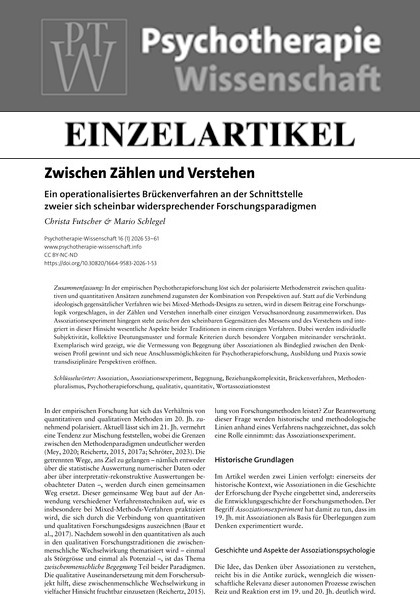
Downloads
How to Cite
Futscher, C., & Schlegel, M. (2026). Between counting and understanding: An operationalized bridging procedure at the interface of two seemingly contradictory research paradigms. Psychotherapie-Wissenschaft, 16(1), 53–61. https://doi.org/10.30820/1664-9583-2026-1-53
Issue
Section
Original Work
License

This work is licensed under a Creative Commons Attribution-NonCommercial-NoDerivatives 3.0 Unported License.
This journal provides open access to its content in accordance with the basic premise that the free public availability of research benefits the exchange of knowledge throughout the world.
Authors wishing to publish in this journal agree to the following:
- The author/s retain/s the copyrights and consent/s to initial publication of the work in the journal under a Creative Commons Attribution licence, which allows third parties to use the work by citing the name/s of the author/s and this journal as initial publisher (in accordance with the Creative Commons Attribution-NonCommercial-NoDerivs 3.0 DE-Licence).
- The author/s can enter into additional contracts for the non-exclusive distribution (e.g. publish in a collection or book) of the version published in the journal, if the journal is cited as initial publisher.