Can art therapy be helpful in oncological rehabilitation?
DOI:
https://doi.org/10.30820/1664-9583-2026-1-15Keywords:
Art Therapy, Oncology, RehabilitationAbstract
Thanks to advances in cancer detection and treatment, the field of oncological rehabilitation is becoming increasingly important. To improve the effectiveness of oncological rehabilitation, mind-body interventions such as art therapy (AT) can be used to help patients understand and manage the complex psychological and emotional consequences of cancer. The aim of this study is to compare the effectiveness of a multidisciplinary oncology rehabilitation program in combination with a AT group intervention with the effectiveness of the conventional program in improving physical and cognitive rehabilitation outcomes in cancer patients. In addition, it aims to examine participants’ subjective experiences and perceived benefits related to AT. This study is a retrospective observational study with measurements before and after the intervention. Sociodemographic variables, clinical information and rehabilitation outcomes collected as part of the National Rehabilitation Measurement Plan of the Swiss National Association for Quality Development in Hospitals and Clinics (ANQ) were analysed. To measure rehabilitation effectiveness, rehabilitation indices (Res) were calculated based on the values of the Functional Independent Measure (FIM). The subjectively perceived benefit of the participants was recorded especially for this study at the end of the AT intervention with the help of a specially developed questionnaire. The final sample included 102 cancer patients who participated in an inpatient rehabilitation program at the CREOC rehabilitation clinic in Novaggio, Switzerland. The intervention group (IG) consisted of 54 participants and the control group (KG) of 48. The participants of the AT-group showed a greater improvement in motor and concentration camp cognitive functions compared to the KG. This finding supports the hypothesis that AT is an intervention that can significantly affect patients’ cognitive and motor functions, which is reflected in traditional rehabilitation indicators. It is also a therapeutic tool that supports patients throughout the rehabilitation program. According to this interpretation, most participants perceived AT as a »personal development experience» and reported that it helped them improve their perceived »treatment potential». Our results suggest that AT can significantly improve the outcomes of traditional cancer rehabilitation, as measured by cognitive and motor function status, by strengthening patient autonomy. AT thus represents a non-specific therapeutic tool that can be useful for patients with different clinical pictures and offer benefits in different contexts. A hospital that integrates AT interventions into cancer rehabilitation can better support cancer patients with different conditions, personality traits and needs through the use of a practical, cost-effective and efficient tool.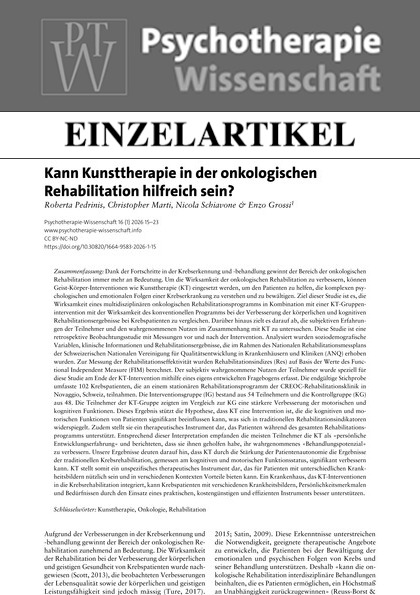
Downloads
How to Cite
Pedrinis, R., Marti, C., Schiavone, N., & Grossi, E. (2026). Can art therapy be helpful in oncological rehabilitation?. Psychotherapie-Wissenschaft, 16(1), 15–23. https://doi.org/10.30820/1664-9583-2026-1-15
Issue
Section
Special Issue
License

This work is licensed under a Creative Commons Attribution-NonCommercial-NoDerivatives 3.0 Unported License.
This journal provides open access to its content in accordance with the basic premise that the free public availability of research benefits the exchange of knowledge throughout the world.
Authors wishing to publish in this journal agree to the following:
- The author/s retain/s the copyrights and consent/s to initial publication of the work in the journal under a Creative Commons Attribution licence, which allows third parties to use the work by citing the name/s of the author/s and this journal as initial publisher (in accordance with the Creative Commons Attribution-NonCommercial-NoDerivs 3.0 DE-Licence).
- The author/s can enter into additional contracts for the non-exclusive distribution (e.g. publish in a collection or book) of the version published in the journal, if the journal is cited as initial publisher.