Enabling healing instead of managing symptoms
An integrative schema therapy framework for the treatment of severe mental illness
DOI:
https://doi.org/10.30820/1664-9583-2025-2-35Keywords:
Schema Therapy, severe mental illness, healthy adult mode, therapeutic relationship, ISTDP, Integrative PsychotherapyAbstract
Severe mental illnesses such as schizophrenia-related syndromes pose significant challenges to treatment, care, and prevention. Despite a wide range of available interventions, a unifying framework that integrates therapeutic, institutional, and societal levels is often lacking. This article proposes a schema therapy-based and metapsychologically expanded understanding that incorporates a structure-oriented perspective, current neurobiological research, and key principles of emotion-focused psychotherapy (ISTDP, EDT). The central focus is on strengthening the Healthy Adult Mode as a therapeutic goal. In addition to clinical treatment, the paper highlights the importance of preventive approaches – with reference to ACEs, the ICF framework, and transdiagnostic perspectives on care. The article advocates for a coordinated, humanistic, and evidence-based understanding of psychological healing.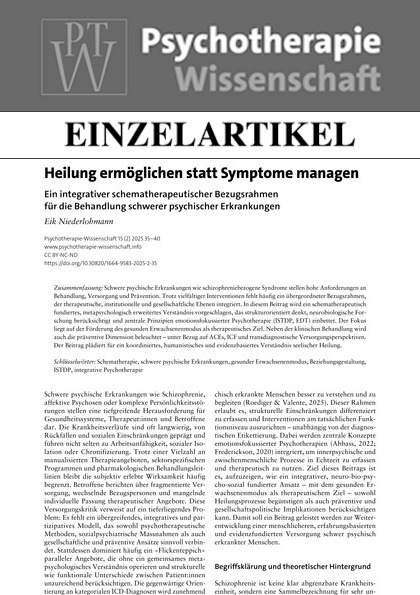
Downloads
Published
2025-10-11
How to Cite
Niederlohmann, E. (2025). Enabling healing instead of managing symptoms: An integrative schema therapy framework for the treatment of severe mental illness. Psychotherapie-Wissenschaft, 15(2), 35–40. https://doi.org/10.30820/1664-9583-2025-2-35
Issue
Section
Original Work
License
Copyright (c) 2025 Eik Niederlohmann

This work is licensed under a Creative Commons Attribution-NonCommercial-NoDerivatives 3.0 Unported License.
This journal provides open access to its content in accordance with the basic premise that the free public availability of research benefits the exchange of knowledge throughout the world.
Authors wishing to publish in this journal agree to the following:
- The author/s retain/s the copyrights and consent/s to initial publication of the work in the journal under a Creative Commons Attribution licence, which allows third parties to use the work by citing the name/s of the author/s and this journal as initial publisher (in accordance with the Creative Commons Attribution-NonCommercial-NoDerivs 3.0 DE-Licence).
- The author/s can enter into additional contracts for the non-exclusive distribution (e.g. publish in a collection or book) of the version published in the journal, if the journal is cited as initial publisher.