Modulation of autonomic regulatory processes in ME/CFS within psychotherapy
DOI:
https://doi.org/10.30820/1664-9583-2026-2-49Keywords:
myalgic encephalomyelitis/chronic fatigue syndrome (ME/CFS), psychotherapy, autonomic dysfunction, post-exertional malaise (PEM)Abstract
This article deepens and expands existing psychotherapeutic approaches to myalgic encephalomyelitis/chronic fatigue syndrome (ME/CFS). The focus is on interventions that aim to modulate the recovery dynamics of the autonomic nervous system (ANS) after stress stimuli. Autonomic dysfunctions are a common feature of ME/CFS. Studies show not only increased orthostatic symptoms and significant changes in cardiovascular parameters compared to control groups, but also autonomic dysfunctions in various organ systems. In addition, reduced parasympathetic reactivity after stress has been demonstrated. Since classic psychotherapeutic approaches, which primarily interpret ME/CFS as a psychosocial stress reaction, have been experienced as stressful by many affected individuals, adjustments are required that take pathophysiological exercise intolerance into account. The author has already outlined some initial approaches to this in an earlier publication. In view of the current state of research, the author focuses on the prolonged autonomic readjustment phase after exertion, which may contribute to the persistence of fatigue and post-exertional malaise (PEM). PEM is defined as a systemic worsening of symptoms after exertion, which often occurs with a temporal delay. Psychotherapeutic interventions for reducing sympathetic activity are proposed. It is possible that specific psychotherapeutic support in regulating the ANS could help to improve recovery processes after exertion and after PEM. The therapeutic goal shifts from improving performance to improving parasympathetic regeneration capacity. So far, there are no empirical studies on such a psychotherapeutic approach to ME/CFS.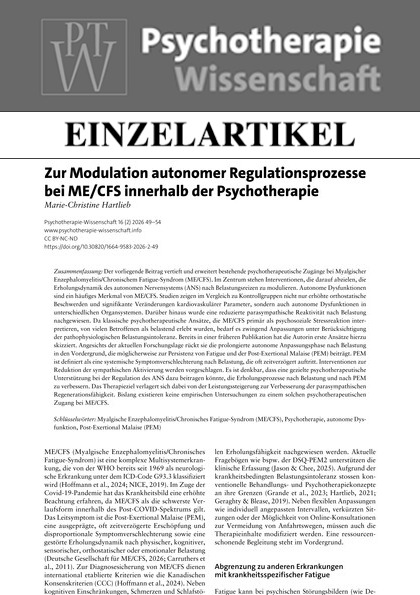
Downloads
How to Cite
Hartlieb, M.-C. (2026). Modulation of autonomic regulatory processes in ME/CFS within psychotherapy. Psychotherapie-Wissenschaft, 16(2), 49–54. https://doi.org/10.30820/1664-9583-2026-2-49
Issue
Section
Original Work
License

This work is licensed under a Creative Commons Attribution-NonCommercial-NoDerivatives 3.0 Unported License.
This journal provides open access to its content in accordance with the basic premise that the free public availability of research benefits the exchange of knowledge throughout the world.
Authors wishing to publish in this journal agree to the following:
- The author/s retain/s the copyrights and consent/s to initial publication of the work in the journal under a Creative Commons Attribution licence, which allows third parties to use the work by citing the name/s of the author/s and this journal as initial publisher (in accordance with the Creative Commons Attribution-NonCommercial-NoDerivs 3.0 DE-Licence).
- The author/s can enter into additional contracts for the non-exclusive distribution (e.g. publish in a collection or book) of the version published in the journal, if the journal is cited as initial publisher.