Hope in Dialogue
Psycho-oncological Precision at the End of Life Between Dignity, Truth, and Choice
DOI:
https://doi.org/10.30820/1664-9583-2026-1-7Keywords:
psycho-oncology, end of life, demoralization, fear of progression, total pain, dignity, Meaning-Centered Psychotherapy, CALM, Dignity TherapyAbstract
The final phase of advanced cancer is rarely a purely medical endpoint. It represents a concentration of fear, pain, relational challenges, and existential questions of meaning, dignity, and connectedness. In this context, psycho-oncological support can be effective not primarily through extended treatment programs, but through precise, well-timed interventions. This requires a shift in perspective: away from an exclusive focus on survival time toward the question of how life can remain shapeable even under conditions of limited time. Based on an experience-informed, integrative, and practice-oriented synthesis of literature and concepts, this article develops an orienting model for psycho-oncological care at the end of life that is not limited to psycho-oncology specialists. Psychological distress is conceptualized as typically manifesting as demoralization, fear of progression or death, depressive symptoms, and «total pain», each requiring distinct priorities for indication, communication, and intervention across care settings. Three narrative case vignettes drawing on Meaning-Centered Psychotherapy, CALM, and Dignity Therapy illustrate the clinical logic of this approach.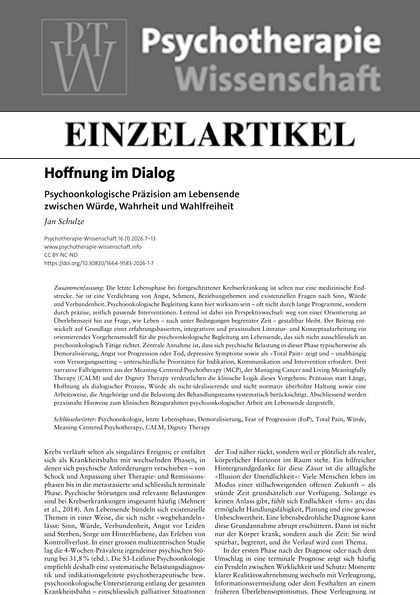
Downloads
How to Cite
Schulze, J. (2026). Hope in Dialogue: Psycho-oncological Precision at the End of Life Between Dignity, Truth, and Choice. Psychotherapie-Wissenschaft, 16(1), 7–13. https://doi.org/10.30820/1664-9583-2026-1-7
Issue
Section
Special Issue
License

This work is licensed under a Creative Commons Attribution-NonCommercial-NoDerivatives 3.0 Unported License.
This journal provides open access to its content in accordance with the basic premise that the free public availability of research benefits the exchange of knowledge throughout the world.
Authors wishing to publish in this journal agree to the following:
- The author/s retain/s the copyrights and consent/s to initial publication of the work in the journal under a Creative Commons Attribution licence, which allows third parties to use the work by citing the name/s of the author/s and this journal as initial publisher (in accordance with the Creative Commons Attribution-NonCommercial-NoDerivs 3.0 DE-Licence).
- The author/s can enter into additional contracts for the non-exclusive distribution (e.g. publish in a collection or book) of the version published in the journal, if the journal is cited as initial publisher.