Autism spectrum: Latest developments pose challenges for adult psychiatry
DOI:
https://doi.org/10.30820/1664-9583-2026-1-35Keywords:
Autism-Spectrum-Disorder, Asperger-Syndrome, public health, diagnosis, treatment, differential diagnosis, developmental disorder, personality disorder, neurodiversityAbstract
Autism, previously a niche issue in adult psychiatry, has emerged as a prominent topic and now ranks, after attention-disorders (ADHD), among the most frequently reported self-diagnoses. Recent developments have led to a concerning overload of the healthcare system, resulting in waiting periods of several months at diagnostic and therapeutic services. This precarious situation is attributable to multiple factors: a conceptual shift; the particularities of a neurodevelopmental disorder within a classification system that primarily addresses diagnoses cross-sectionally and independently of assumed aetiology; problematic assumptions held by both professionals and laypersons; broader societal developments. Although the focus of this article is on autism, many of the observations and considerations are equally applicable to ADHD. Concentrating on adult psychiatry in the German-speaking part of Switzerland, this article delineates the interrelationships and adverse consequences and proposes suggestions for addressing the current challenges.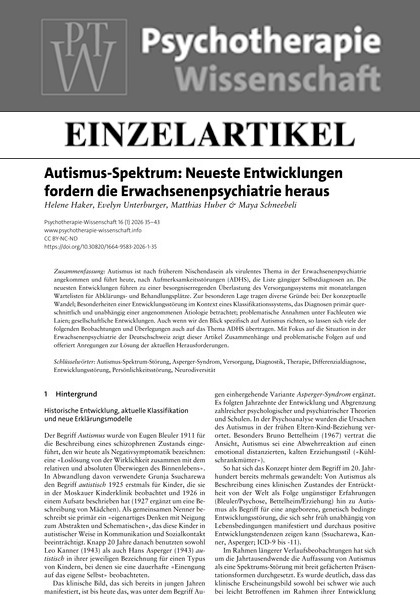
Downloads
How to Cite
Haker, H., Unterburger, E., Huber, M., & Schneebeli, M. (2026). Autism spectrum: Latest developments pose challenges for adult psychiatry. Psychotherapie-Wissenschaft, 16(1), 35–43. https://doi.org/10.30820/1664-9583-2026-1-35
Issue
Section
Original Work
License

This work is licensed under a Creative Commons Attribution-NonCommercial-NoDerivatives 3.0 Unported License.
This journal provides open access to its content in accordance with the basic premise that the free public availability of research benefits the exchange of knowledge throughout the world.
Authors wishing to publish in this journal agree to the following:
- The author/s retain/s the copyrights and consent/s to initial publication of the work in the journal under a Creative Commons Attribution licence, which allows third parties to use the work by citing the name/s of the author/s and this journal as initial publisher (in accordance with the Creative Commons Attribution-NonCommercial-NoDerivs 3.0 DE-Licence).
- The author/s can enter into additional contracts for the non-exclusive distribution (e.g. publish in a collection or book) of the version published in the journal, if the journal is cited as initial publisher.