The helioscope effect
A new concept of trauma processing in psychotherapy with psychedelics
DOI:
https://doi.org/10.30820/1664-9583-2025-2-15Keywords:
trauma, psychotherapy, exposure, safety, side effectsAbstract
The helioscope effect refers to trauma-related memory processing, facilitated by psychedelic substances, in which difficult memories become accessible without compromising emotional safety. The concept is grounded in both qualitative and quantitative research involving substances such as psilocybin, LSD, and MDMA. It identifies three core therapeutic mechanisms: enhanced emotional accessibility, reduced avoidance, and simultaneously increased protection against retraumatization. This effect is supported by specific contextual factors – most notably, therapeutic preparation and integration, clearly defined therapeutic intentions, and a safe, contained setting. The article explores the neurobiological underpinnings of the helioscope effect, its relevance for trauma therapy and its contribution to psychotherapy process research.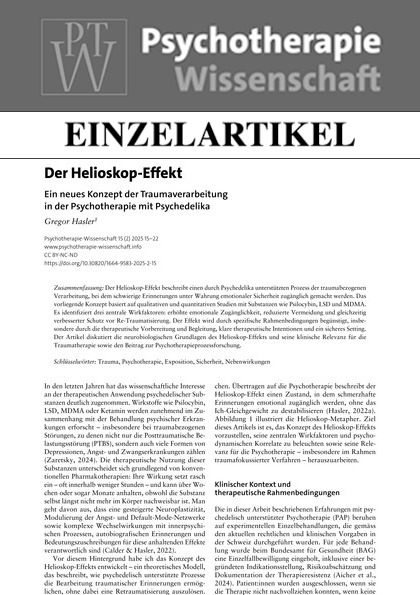
Downloads
Published
2025-10-11
How to Cite
Hasler, G. (2025). The helioscope effect: A new concept of trauma processing in psychotherapy with psychedelics. Psychotherapie-Wissenschaft, 15(2), 15–22. https://doi.org/10.30820/1664-9583-2025-2-15
Issue
Section
Special Issue
License
Copyright (c) 2025 Gregor Hasler

This work is licensed under a Creative Commons Attribution-NonCommercial-NoDerivatives 3.0 Unported License.
This journal provides open access to its content in accordance with the basic premise that the free public availability of research benefits the exchange of knowledge throughout the world.
Authors wishing to publish in this journal agree to the following:
- The author/s retain/s the copyrights and consent/s to initial publication of the work in the journal under a Creative Commons Attribution licence, which allows third parties to use the work by citing the name/s of the author/s and this journal as initial publisher (in accordance with the Creative Commons Attribution-NonCommercial-NoDerivs 3.0 DE-Licence).
- The author/s can enter into additional contracts for the non-exclusive distribution (e.g. publish in a collection or book) of the version published in the journal, if the journal is cited as initial publisher.