On the epistemic autonomy of the science of psychotherapy
A plea for an ethics of reflexive experience
DOI:
https://doi.org/10.30820/1664-9583-2026-2-55Keywords:
psychotherapy science, ethics of reflexive experience, epistemic autonomy, subjective experience, intersubjectivity, not-knowing, tolerance of ambiguity, the irreducibility of human suffering, psychotherapyAbstract
The increasing academization of psychotherapy raises fundamental questions about its scientific positioning and ethical foundations. In particular, trends toward standardization, homogenization, and psychologization threaten to marginalize those dimensions that are constitutive of psychotherapeutic practice: subjective experience, processuality, ambiguity, and the irreducible nature of human suffering. his article argues that psychotherapy follows its own epistemic logic, one that cannot be subsumed under explanatory or technicist models of science. Against this backdrop, the article makes a case for an ethics of reflexive experience as a central prerequisite for the epistemic autonomy of the science of psychotherapy. Knowledge is not understood here as a primary entity, but rather as a derived category that is legitimized only through its engagement with reflexively explored experience, relationships, and time. Training therapy and supervision are identified as central spaces of experience in which this ethical stance is developed and safeguarded against epistemic hubris. This text is intended as a contribution to the self-understanding of the science of psychotherapy and as a counterpoint to standardizing tendencies in current scientific discourse.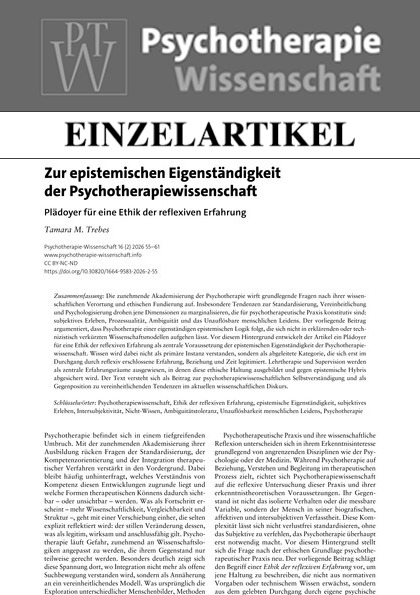
Downloads
How to Cite
Trebes, T. M. (2026). On the epistemic autonomy of the science of psychotherapy: A plea for an ethics of reflexive experience. Psychotherapie-Wissenschaft, 16(2), 55–61. https://doi.org/10.30820/1664-9583-2026-2-55
Issue
Section
Original Work
License

This work is licensed under a Creative Commons Attribution-NonCommercial-NoDerivatives 3.0 Unported License.
This journal provides open access to its content in accordance with the basic premise that the free public availability of research benefits the exchange of knowledge throughout the world.
Authors wishing to publish in this journal agree to the following:
- The author/s retain/s the copyrights and consent/s to initial publication of the work in the journal under a Creative Commons Attribution licence, which allows third parties to use the work by citing the name/s of the author/s and this journal as initial publisher (in accordance with the Creative Commons Attribution-NonCommercial-NoDerivs 3.0 DE-Licence).
- The author/s can enter into additional contracts for the non-exclusive distribution (e.g. publish in a collection or book) of the version published in the journal, if the journal is cited as initial publisher.